An article written by Dr Edward Leatham, Consultant Cardiologist © 2025 E.Leatham
Tags: VAT, Metabolic Health, Stent search website using Tags to find related stories.
Measuring your waist sounds easy — until you try to do it properly.
In modern heart and metabolic medicine, waist circumference is one of the most useful simple health measurements we have. It tells us far more about future risk than weight or BMI alone.
But this only works if the waist is measured in the right place.
This article explains:
- Why the word “waist” causes confusion
- Why measuring the narrowest point is misleading
- What health guidelines actually recommend
- The exact point you should use every time
Why Waist Measurement Matters
Your waist size reflects the amount of visceral fat — the deep fat stored around the liver and other organs.
High visceral fat is linked to:
- High blood pressure
- Type 2 diabetes
- Fatty liver disease
- Heart disease and stroke
This is why organisations such as the World Health Organization and UK health bodies recommend waist measurement as part of routine health assessment.
The Problem With the Word “Waist”
In everyday language, waist usually means:
- The narrowest part of your body
- A feature used for clothing and appearance
- Something that varies with posture and body shape
That makes sense for fashion — but not for health.
In medicine, waist circumference is not about shape.
It is a marker of internal abdominal fat and health risk.
These two meanings share the same word — but they are measuring very different things.
Why Measuring the Narrowest Point Is Misleading
1. It Misses Harmful Fat
Visceral fat sits below the rib cage, pushing the abdomen outwards.
The narrowest point is often above this area.
So visceral fat — and health risk — can increase while the “waist” measurement stays the same.
2. It Changes Over Time
As your body changes:
- The narrowest point can move
- It can disappear or reappear
- Measurements become inconsistent
This makes it unreliable for tracking real health change.
3. It Differs by Sex and Age
- Younger women often have a visible waist curve
- Men and post-menopausal women often do not
This means narrowest-point measurements are not comparable between people.
4. It Undermines the Waist-to-Height Rule
A widely used health rule is:
Keep your waist less than half your height
This only works if the waist is measured at a fixed anatomical level.
Measuring the narrowest point makes risk appear lower than it really is.
What Health Guidelines Recommend
Health organisations deliberately define waist circumference using anatomical landmarks, not appearance.
UK guidance (including NHS-endorsed advice) increasingly supports waist-to-height ratio, provided waist is measured correctly.
The goal is consistency and risk prediction — not aesthetics.
How to Measure Your Waist Correctly

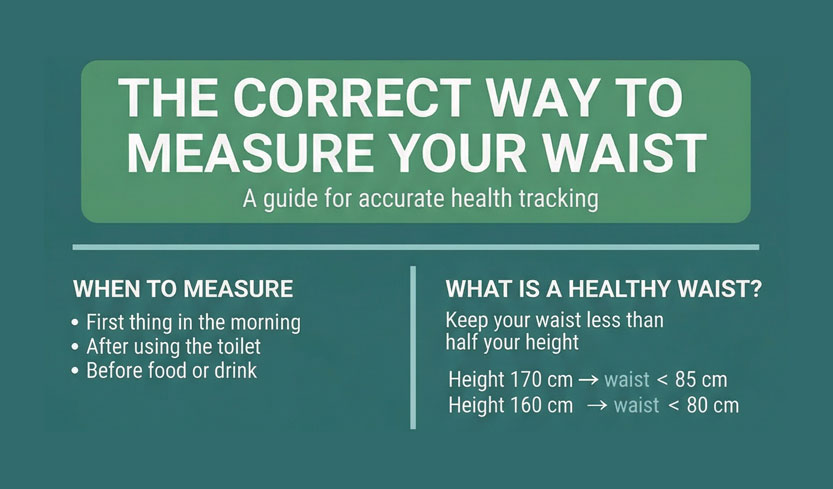
When to Measure
- First thing in the morning
- After using the toilet
- Before food or drink
Stand upright and relaxed. Do not suck your stomach in.
🔲 BOX: THE EXACT POINT TO USE (IMPORTANT)
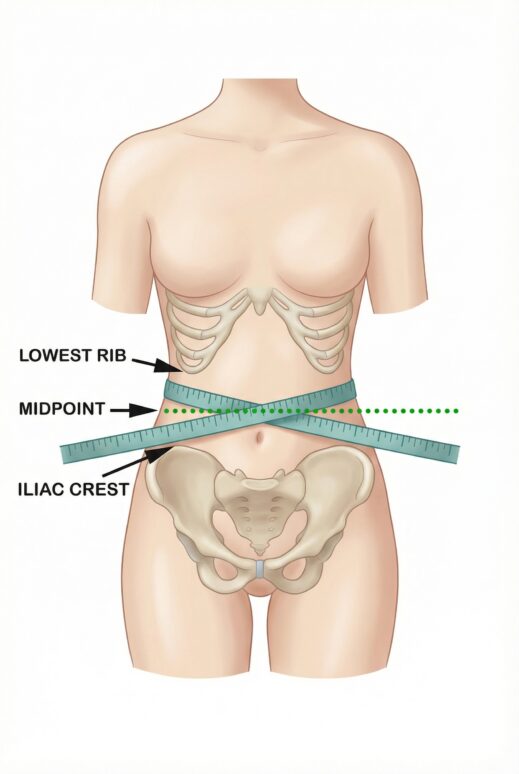
Standard Waist Measurement for Health
- Stand upright with feet shoulder-width apart
- Find:
- The lowest rib
- The top of the hip bone (iliac crest)
- Place the tape halfway between these two points
- Keep the tape:
- Horizontal
- Against bare skin
- Snug but not tight
- Breathe out normally and record the number
Use this exact point every time.
Do not:
- Measure the narrowest part
- Pull the tape tight
- Measure over clothing
Practical Tips for Consistency
Patients often notice:
- Waist size changes during the day
- Bloating affects measurements
Helpful tips:
- Measure at the same time of day
- Use a mirror to keep the tape level
- Measure once a week, not daily
- Focus on the trend, not one reading
- Write in down in a year book diary, like the one we use at SCVC – see book section of my Toolkit blog
Consistency matters more than perfection.
What Is a Healthy Waist?
Waist-to-Height Ratio (Simple and Reliable)
Your waist should be less than half your height
Examples:
- Height 170 cm → waist < 85 cm
- Height 160 cm → waist < 80 cm
WHO High-Risk Thresholds
- Men: >102 cm
- Women: >88 cm
These thresholds only make sense if waist is measured correctly.
Common Mistakes to Avoid
- Measuring after meals
- Pulling the tape tight “for motivation”
- Changing where you measure each time
- Using clothing sizes instead of a tape
The Take-Home Message
The issue is not effort — it’s language.
- “Waist” in everyday life describes shape
- “Waist circumference” in medicine describes health risk
Measuring the narrowest point:
- Feels intuitive
- Often gives flattering numbers
- But underestimates cardiometabolic risk
If your goal is health, prevention, and tracking real change, the narrowest point is the wrong place.
Related Blogs
- N-of-1: Why Your Best Health Plan Starts With You
- Sarcopenia: Are We Diagnosing the Correct Muscle Problem?
- Medical imaging is the only accurate way to assess body composition
- If You’ve Had a Stent, Check Your Waist
- Examples of CT VAT scans and normal ranges for VATI
- Why everyone is talking about VAT
- Smart body composition scales: helpful metabolic tool—or misleading distraction?
- Metabolic Toolkit
References
- World Health Organization. Waist circumference and waist–hip ratio: report of a WHO expert consultation. Geneva: WHO; 2008.
https://www.who.int/publications/i/item/9789241501491 - National Institute for Health and Care Excellence (NICE). Obesity: identification, assessment and management. CG189.
https://www.nice.org.uk/guidance/cg189 - Ashwell M, Gibson S. A proposal for a primary screening tool: “Keep your waist circumference to less than half your height”. BMC Med. 2014;12:207.
https://bmcmedicine.biomedcentral.com/articles/10.1186/s12916-014-0207-1 - Ross R, Neeland IJ, Yamashita S, et al. Waist circumference as a vital sign in clinical practice. Nat Rev Endocrinol. 2020;16:177–189.
https://www.nature.com/articles/s41574-019-0310-7 - Klein S, Allison DB, Heymsfield SB, et al. Waist circumference and cardiometabolic risk. Am J Clin Nutr. 2007;85:1197–1202.
https://academic.oup.com/ajcn/article/85/5/1197/4633007 - Public Health England. Adult obesity: applying All Our Health.
https://www.gov.uk/government/publications/adult-obesity-applying-all-our-health