An article by Dr Edward Leatham, Consultant Cardiologist © 2025 E.Leatham
Tags ED, GLP, N-of-1, VAT
A personal experiment worth running
This is the first article in my N-of-1 series, where patients are encouraged to test a plausible hypothesis on themselves — using their own baseline as the control — to see whether a specific change genuinely improves their health and wellbeing, judged by outcomes they can measure and feel.
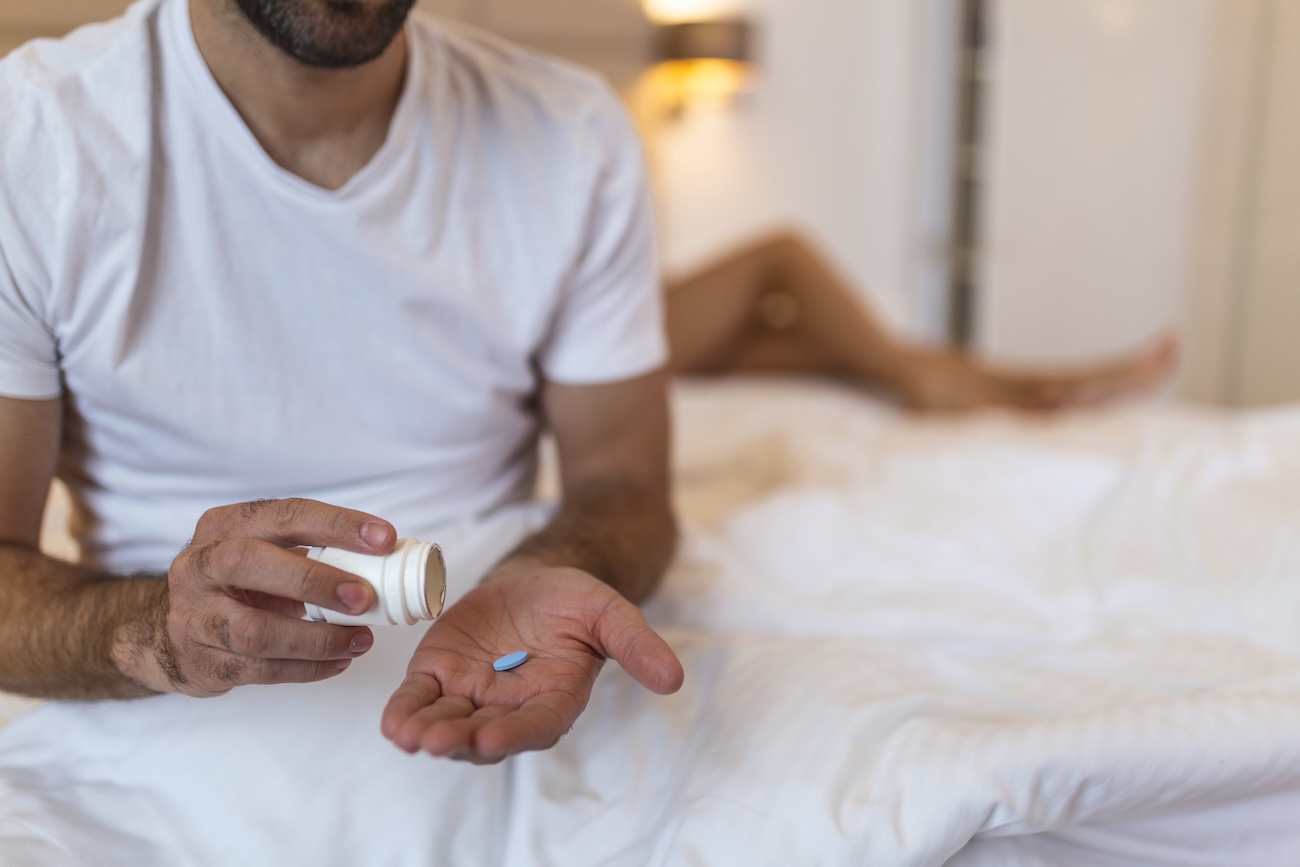
Most men who develop erectile dysfunction assume something mechanical has gone wrong — that blood simply isn’t getting where it needs to go.
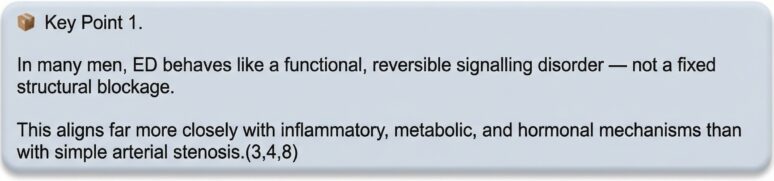
That assumption is understandable. But it doesn’t sit comfortably with what we actually see when men with erectile dysfunction (ED) are investigated. Penile arterial stenosis is uncommon. Duplex studies are often near-normal. There is rarely a single obstructive lesion that explains the symptoms.
And yet, something interesting happens in clinic.
When men lose weight — particularly when their waist size comes down — erectile function often improves. Sometimes modestly, sometimes dramatically, often without any change in medication.(1)
That observation doesn’t prove anything.
But it does raise an important question.
What if, in many men, ED is not a plumbing problem at all — but a reversible metabolic and signalling problem, driven by visceral fat?
A hypothesis worth testing, not proclaiming
There is no large randomised trial showing that reducing visceral adipose tissue (VAT) treats erectile dysfunction. No guideline recommends waist reduction as ED therapy. Drugs such as sildenafil clearly work — and they have transformed quality of life for millions of men.
So why would a cardiologist suggest that a man with ED and a raised waist circumference consider an experiment on himself?
Because sometimes medicine lags behind biology. And because this particular hypothesis is biologically plausible, low-risk to test, and potentially high-reward.
The hypothesis is simple:
In many men with raised waist to height ratio >0.5, erectile dysfunction is driven less by fixed arterial narrowing and more by visceral fat disrupting endothelial signalling, insulin action, inflammatory balance, and hormonal tone.
If that is true, then reducing visceral fat should improve erectile function — even when arterial scans look “normal”.
This idea does not rest on a single study. It emerges from patterns — across physiology, epidemiology, intervention trials, and everyday clinical experience.(2–5)
What visceral fat actually does
Visceral fat is not passive storage tissue. It behaves like an active endocrine organ.
It releases inflammatory cytokines and adipokines that interfere with vascular signalling, insulin sensitivity, and nitric-oxide bioavailability. These effects occur well before diabetes develops, often while routine blood tests still look reassuring.(5–7). Experimental and translational studies show that inflammatory signalling arising from adipose tissue directly impairs endothelial nitric-oxide synthesis, increases oxidative stress, and disrupts insulin-mediated vasodilation — creating a biological environment that is hostile to normal erectile physiology.(8) Erections depend on exquisitely sensitive endothelial signalling. Nitric oxide must be released at the right moment, smooth muscle must relax appropriately, and insulin signalling plays a permissive role in that process.(9)
Visceral fat disrupts all of this — without causing visible obstruction.
That distinction matters. It explains why ED can fluctuate, why improvement can occur relatively quickly, and why investigations so often fail to reveal a neat anatomical cause.

Why drugs can work — and then stop working
PDE-5 inhibitors do not create erections on their own. They amplify nitric-oxide signalling that is already present.
If visceral fat suppresses nitric-oxide production through inflammatory and insulin-resistant pathways, the response to these drugs becomes blunted. Doses creep up. Reliability fades. Men are told the drug has “stopped working”.
When visceral fat is reduced, endothelial signalling often improves — and the same drug may suddenly work better again.(1,4)
This does not require plaque regression or artery widening. It reflects restoration of biological responsiveness, not mechanical repair.
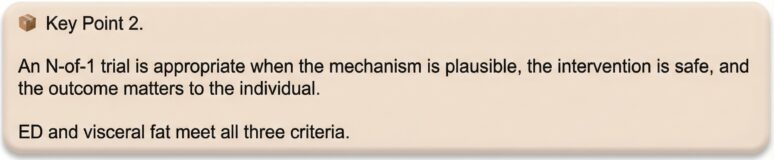
Why this is ideal for an N-of-1 experiment
This is where the idea of N-of-1 medicine becomes powerful.
Population studies tell us what happens on average. They are slow, expensive, and necessarily cautious. Individuals, however, do not live as averages. When evidence is suggestive rather than definitive, the most honest next step may be personal experimentation.
Reducing visceral fat is not an exotic intervention. It is already recommended for cardiometabolic prevention. Erectile function, meanwhile, is a highly sensitive and personally meaningful outcome.
That combination makes this a rare thing in medicine:
a low-risk intervention with a highly motivating, rapidly observable signal.(1,5)
How a personal experiment might look
This is not about perfection or transformation. It is about direction.
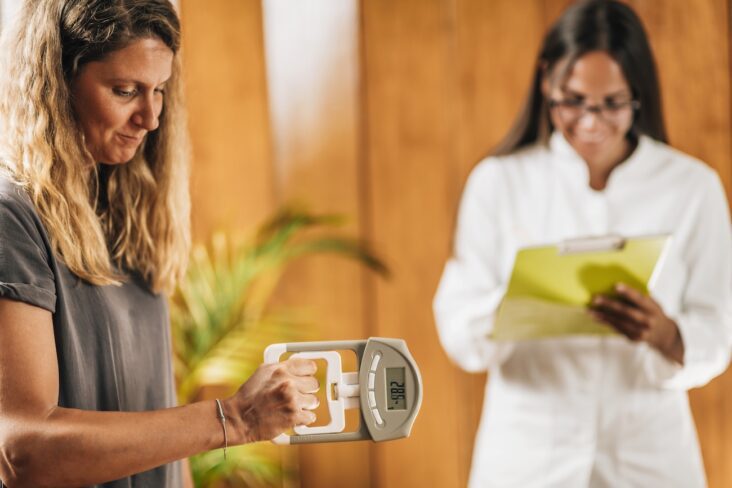
A man starts by noting his baseline: waist circumference, erectile reliability, confidence, and medication use. He then commits to a defined period — perhaps three or four months — with a single primary aim: reducing visceral fat.
The tools matter less than consistency. Calorie control, protein prioritisation, resistance training, glucose awareness, or medically supervised metabolic therapies may all play a role. What matters is that the intervention is sustained long enough to alter VAT biology.
At the end, the question is simple:
Did reducing my waist change my erectile function?
If the answer is no, that is still useful information.
If the answer is yes, the insight is profound — because it is personal, not theoretical.
Why sex is a powerful lever (and that’s okay)
Most men do not change behaviour because they are warned about a heart attack in ten years’ time.
Many will change behaviour if they believe something might improve their sex life in three months.
That is not vanity — it is human motivation. Visceral fat is strongly defended by the body, and rational arguments often fail. Emotionally meaningful incentives succeed.
Framing this as an experiment — not a promise — allows curiosity to replace shame or fear.
ED may be one of the earliest and most personally meaningful signals of VAT-driven metabolic dysfunction — and therefore one of the strongest motivators to reverse it.
What this is — and what it isn’t
This is not a claim that losing belly fat will cure ED in all men. Neurogenic, psychogenic, and advanced structural causes exist, and ED medications remain invaluable.
This is an invitation to test a hypothesis that medicine has not yet formally settled — but that biology, physiology, and clinical experience increasingly support.
In other words:
Don’t assume the answer — run the experiment.
That is N-of-1 medicine.
Important disclaimerThe information in this blog is provided for general educational purposes only. It does not constitute personal medical advice, diagnosis, or treatment, and should not be used as a substitute for consultation with your own doctor or healthcare professional. Some articles on this site explore N-of-1 (single-person) experiments, where individuals test plausible, low-risk hypotheses on themselves to better understand how their own body responds. These examples are not guarantees of benefit, and responses vary between individuals. You should not start, stop, or change any prescribed medication, or undertake significant lifestyle or health interventions, without appropriate medical advice. If you have a medical condition, symptoms, or concerns — or if you are unsure whether an approach discussed here is suitable for you — please seek advice from a qualified healthcare professional who knows your personal medical history. |
References
- Esposito K, Giugliano F, Di Palo C, Giugliano G, Marfella R, D’Andrea F, et al. Effect of Lifestyle Changes on Erectile Dysfunction in Obese MenA Randomized Controlled Trial. JAMA [Internet]. 2004 Jun 23 [cited 2026 Feb 4];291(24):2978–84. Available from: https://doi.org/10.1001/jama.291.24.2978
- Dong JY, Zhang YH, Qin LQ. Erectile Dysfunction and Risk of Cardiovascular Disease. J Am Coll Cardiol [Internet]. 2011 Sep [cited 2026 Feb 4];58(13):1378–85. Available from: https://linkinghub.elsevier.com/retrieve/pii/S0735109711024223
- Montorsi P, Ravagnani PM, Galli S, Rotatori F, Briganti A, Salonia A, et al. The Artery Size Hypothesis: A Macrovascular Link Between Erectile Dysfunction and Coronary Artery Disease. Am J Cardiol [Internet]. 2005 Dec 26 [cited 2026 Feb 4];96(12, Supplement 2):19–23. Available from: https://www.sciencedirect.com/science/article/pii/S0002914905011215
- Vlachopoulos C, Jackson G, Stefanadis C, Montorsi P. Erectile dysfunction in the cardiovascular patient. Eur Heart J. 2013 Jul;34(27):2034–46.
- Traish AM, Feeley RJ, Guay A. Mechanisms of obesity and related pathologies: androgen deficiency and endothelial dysfunction may be the link between obesity and erectile dysfunction. FEBS J. 2009 Oct;276(20):5755–67.
- Corona G, Vignozzi L, Sforza A, Mannucci E, Maggi M. Obesity and late-onset hypogonadism. Mol Cell Endocrinol. 2015 Dec 15;418 Pt 2:120–33.
- Guria S, Hoory A, Das S, Chattopadhyay D, Mukherjee S. Adipose tissue macrophages and their role in obesity-associated insulin resistance: an overview of the complex dynamics at play. Biosci Rep [Internet]. 2023 Mar 9 [cited 2026 Feb 4];43(3):BSR20220200. Available from: https://doi.org/10.1042/BSR20220200
- Traish AM, Feeley RJ, Guay A. Mechanisms of obesity and related pathologies: Androgen deficiency and endothelial dysfunction may be the link between obesity and erectile dysfunction. FEBS J [Internet]. 2009 [cited 2026 Feb 4];276(20):5755–67. Available from: https://onlinelibrary.wiley.com/doi/abs/10.1111/j.1742-4658.2009.07305.x
- Traish A, Kim N. The physiological role of androgens in penile erection: regulation of corpus cavernosum structure and function. J Sex Med. 2005 Nov;2(6):759–70.
Related posts
- N-of-1: When You Become the Study
- Cardiometabolic toolkit
- How to Reduce Visceral Fat Without Medication
- Why Protein Matters More Than Ever as We Age
- How to Lose Visceral Adipose Tissue (VAT) and Improve Metabolic Health: A Guide to Sustainable Weight Loss
- Why everyone is talking about VAT
- Examples of CT VAT scans and normal ranges for VATI
- Visceral Fat, Mitochondria, and the Energy Trap: Why We Store Fat Where We Shouldn’t
- Carbohydrate Sensitive Phenotype (CSP): Precursor of the Metabolic Syndrome?
- Exercise and Digital Tools Should Be the First Line in Reducing Visceral Fat in Cardiac Patients
- Cardiologists and a New Enemy: Evolving Tools of the Trade
- Carbohydrate Sensitive Phenotype (CSP): Precursor of the Metabolic Syndrome?
- Metabolic Health Assessment
- Biofeedback: CGM metrics improve after just 4 weeks of dietary intervention
- Lets compare continuous glucose monitor (CGM) results
| N-of-1 Companion Diary A 12-month metabolic diary designed to support N-of-1 experiments by tracking waist, weight, strength, activity, and symptoms over time — helping you use yourself as the control and focus on trends that matter, not just the scale. 🔗 https://amzn.eu/d/0hBEpKDU |