An article written by Dr Edward Leatham, Consultant Cardiologist © 2025 E.Leatham
A new SCVC book on personalised metabolic and cardiovascular health
At Surrey Cardiovascular Clinic, one consistent pattern stands out: even when two people share the same diagnosis or the same medication, their bodies respond differently. Appetite, sleep quality, glucose responses, muscle mass, cravings and stress patterns vary widely between individuals.
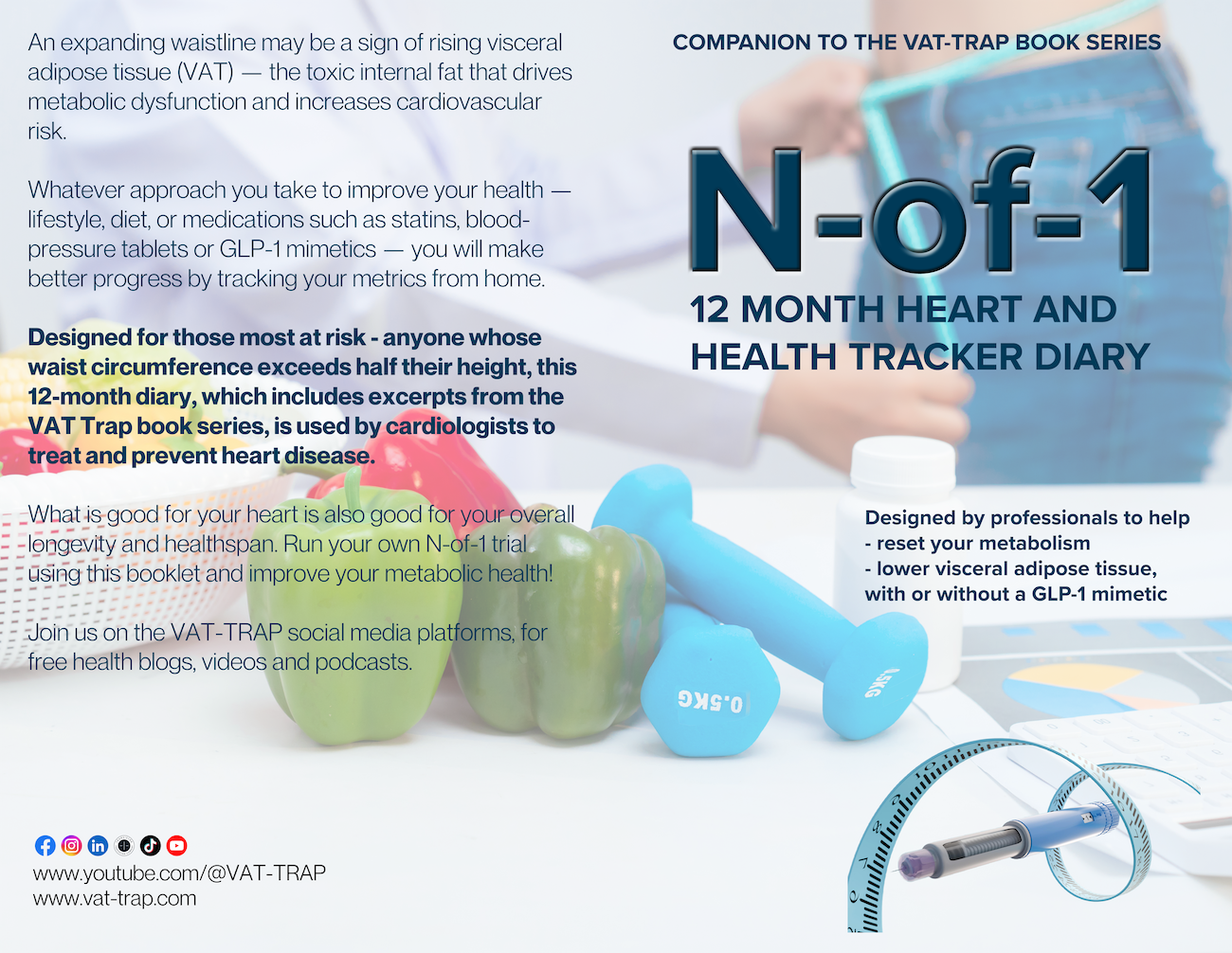
A new 24 page diary — N-of-1 — is written to reflect this reality.
As a companion book in the VAT-TRAP series, N-of-1 introduces the concept of personalised metabolic improvement: you are your own study, your own experiment, your own N-of-1 trial.
What Is an N-of-1 Trial?
Whether you need to lower your blood pressure, weight or waist to improve your metabolic health and healthspan, the N-of-1 technique is a personalised experiment where you:
- change one variable at a time
- observe your own responses
- keep what works
- discard what doesn’t
This mirrors how clinicians personalise treatment daily.
Rather than following generic rules, you work with your own biology — a precision-medicine approach that research increasingly supports¹².
Why This Diary Was Developed
The book series draws on years of cardiology practice treating people with raised visceral adipose tissue (VAT, or belly fat), metabolic drift, glucose variability, weight regain and midlife loss of metabolic flexibility.
A key insight emerged:
Metabolic decline is slow, subtle and often symptomless — and metabolic recovery must be slow, steady and data-guided.
VAT accumulates invisibly over years³⁻⁷.
Sleep disruption, glucose spikes, rising fasting insulin and gradual muscle loss quietly shift the brain’s “defended” weight set point.
Short programmes and rapid weight-loss plans do not reverse these deeper systems.
N-of-1 offers a more realistic path:
a structured, reflective approach that uses small weekly changes to drive measurable long-term improvement.
Why N-of-1 Matters More Than Ever
Modern cardiometabolic science makes this clear:
- VAT is a powerful driver of heart disease, metabolic syndrome, dementia and cancer³⁻⁷
- Metabolic dysfunction begins long before diabetes or hypertension appear⁸
- GLP-1 mimetics reduce VAT but require muscle preservation and lifestyle structure⁹
- Tools like CGM, body composition scales and food-analysis apps allow precise early course-correction¹⁰⁻¹¹
N-of-1 shows how to use these tools intelligently — without overwhelm.
What You’ll Learn in the N-of-1 Book
✔ How to run an N-of-1 trial on yourself
Small weekly experiments guided by your own data, not guesswork.
✔ Why slow metabolic change works best
Because VAT biology, mitochondrial function, appetite signalling and liver metabolism adapt gradually⁴⁻⁷.
✔ The four foundations of metabolic reset
- Nutrition
- Movement
- Muscle
- Sleep
Excerpts explain simply and practically.
✔ How to interpret modern metabolic tools
Including glucose responses, body composition, measurement of VAT risk, and understanding GLP-1 effects.
✔ How to build sustainable metabolic habits
Not via intensity or restriction, but by steady repetition, reflection and insight.
Who N-of-1 is For
This book is suitable for:
- anyone with waist-to-height ratio >0.5
- people beginning a 12-month metabolic reset
- patients using GLP-1 mimetics
- individuals noticing midlife metabolic drift
- anyone seeking personalised rather than generic health advice
- those aiming to reduce VAT and improve long-term cardiovascular health
Why Slow Change Is More Effective
Fast approaches often:
- reduce skeletal muscle
- trigger rebound appetite
- lower resting metabolic rate
- accelerate VAT re-accumulation
Slow change allows the body to realign core systems — hypothalamic signalling, insulin sensitivity, muscle glucose uptake and circadian rhythms⁴⁻⁷.
This is the physiological basis for N-of-1:
small, steady improvements beat dramatic short-term efforts.
N-of-1 and GLP-1 Therapy
GLP-1 mimetics such as semaglutide and tirzepatide:
- reduce visceral fat
- improve glucose variation
- lower liver fat
- calm appetite
But they must be paired with nutrition, sleep and resistance training if long-term metabolic stability is the goal⁹.
N-of-1 explains how to integrate medication safely into a sustainable metabolic plan, and how to taper thoughtfully when appropriate.
A Personal Roadmap to Metabolic Health
N-of-1 is not a diet, a challenge or a fixed programme.
It is a mindset — a precision, personalised approach to long-term health.
Using modern tools, weekly reflections and structured self-experimenting, the book helps you understand:
- your metabolic patterns
- your sleep–glucose interactions
- your biological triggers
- your appetite cycles
- your responsiveness to change
You cannot rush metabolic health.
But you can reclaim it — one week, one habit, one experiment at a time.
Learn more at: www.vat-trap.com
Or see the metabolic toolkit page to link to recommended books with a link to the N-of-1 companion diary
References
- Guyatt G, Sackett D, Taylor DW, Ghong J, Roberts R, Pugsley S. Determining Optimal Therapy — Randomized Trials in Individual Patients. N Engl J Med [Internet]. 1986 Apr 3 [cited 2026 Feb 4];314(14):889–92. Available from: https://www.nejm.org/doi/full/10.1056/NEJM198604033141406
- Kravitz RL, Duan N, Niedzinski EJ, Hay MC, Subramanian SK, Weisner TS. What Ever Happened to N-of-1 Trials? Insiders’ Perspectives and a Look to the Future. Milbank Q [Internet]. 2008 Dec [cited 2026 Feb 4];86(4):533–55. Available from: https://pmc.ncbi.nlm.nih.gov/articles/PMC2690377/
- Nikles CJ, Glasziou PP, Del Mar CB, Duggan CM, Mitchell G. N of 1 trials. Practical tools for medication management. Aust Fam Physician. 2000 Nov;29(11):1108–12.
- Shamseer L, Sampson M, Bukutu C, Schmid CH, Nikles J, Tate R, et al. CONSORT extension for reporting N-of-1 trials (CENT) 2015: Explanation and elaboration. 2015 May 14 [cited 2026 Feb 4]; Available from: https://www.bmj.com/content/350/bmj.h1793
- Lillie EO, Patay B, Diamant J, Issell B, Topol EJ, Schork NJ. The n-of-1 clinical trial: the ultimate strategy for individualizing medicine? Pers Med. 2011 Mar;8(2):161–73.
Other related articles
- Visceral Fat, Mitochondria, and the Energy Trap: Why We Store Fat Where We Shouldn’t
- How to Lose Visceral Adipose Tissue (VAT) and Improve Metabolic Health: A Guide to Sustainable Weight Loss
- The Expanding Waistline in Men: Spare Tyre, Killer Visceral Fat, or Just Flabby Abdominal muscles?
- GLP-1 mimetic clinic
- Effects of different exercise types on visceral fat in young individuals with obesity aged 6–24 years old: A systematic review and meta-analysis 2022
- Clinical significance of visceral adiposity assessed by computed tomography: A Japanese perspective: 2014
- From Genes to Greens: How DNA Shapes Your Nutritional Needs
- Visceral and ectopic fat, atherosclerosis, and cardiometabolic disease: a position statement 2019
- Body fat distribution on computed tomography imaging and prostate cancer risk and mortality in the AGES-Reykjavik study 2019