An article written by Dr Edward Leatham, Consultant Cardiologist © 2024 E.Leatham
For busy people, or to tune in when on the move, Google Notebook AI audio podcast are available for this story beneath.
If you were asked to identify the non-human organism responsible for the greatest number of human deaths worldwide, the answer might surprise you. It is not the crocodile or the shark, nor domesticated animals such as cows or dogs. Instead, it is the mosquito — a tiny insect that serves as the main vector for malaria, a disease that continues to cause substantial mortality globally, particularly in resource-limited regions.
Interestingly, the genetic variant responsible for sickle cell disease is more common in areas where malaria is endemic. This is because individuals carrying one copy of the mutation have some protection against severe malaria. This represents a classic example of an evolutionary trade-off or heterozygote advantage, in which a genetic variant persists because it provides survival benefit under certain environmental pressures. Importantly, this is not considered a classic gain-of-function mutation in molecular genetics, but rather an altered-function variant with mixed effects.
Following this broader theme of genetic trade-offs, recent research has highlighted another type of mutation — true gain-of-function mutations — that may contribute to coronary artery disease, one of the leading causes of death worldwide.
A Closer Look at Cholesterol and Heart Disease
To understand this concept, it helps to revisit one of the major drivers of coronary artery disease: LDL cholesterol, often referred to as “bad cholesterol.” LDL (low-density lipoprotein) transports cholesterol through the bloodstream. When LDL levels are elevated over time, cholesterol accumulates within artery walls, promoting atherosclerosis — the progressive plaque build-up that increases the risk of heart attack and stroke.
A substantial proportion of cardiovascular risk is associated with LDL cholesterol exposure across the lifespan. For decades, researchers have tried to understand why LDL levels vary so widely between individuals. Genetics has proven to be a major part of that answer.
PCSK9: A Key Regulator of Cholesterol
One of the most important discoveries in lipid biology has been the role of the protein proprotein convertase subtilisin/kexin type 9, or PCSK9.
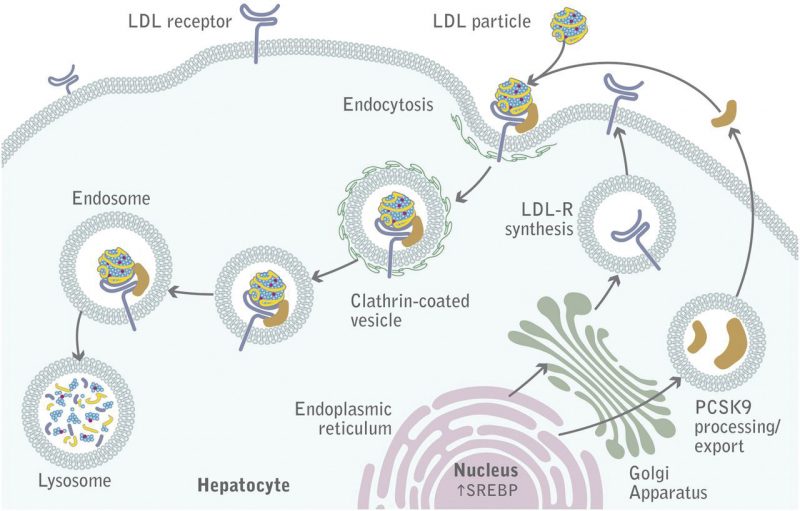
Normally, LDL particles are removed from the bloodstream when they bind to LDL receptors on liver cells (hepatocytes). These receptors internalise LDL and clear it from circulation. PCSK9 regulates this process by binding to LDL receptors and promoting their degradation. When PCSK9 activity increases, fewer LDL receptors remain available, resulting in reduced LDL clearance and higher circulating LDL cholesterol levels.
Gain-of-Function Mutations and LDL Cholesterol
In genetics, a gain-of-function mutation refers to a mutation that increases the activity of a protein or enhances its normal effect. Several mutations in the PCSK9 gene fit this definition precisely.
Individuals carrying PCSK9 gain-of-function mutations produce PCSK9 proteins that are more effective at driving LDL receptor degradation. The consequence is persistently elevated LDL cholesterol and a higher risk of premature coronary artery disease. These mutations are well recognised as one cause of familial hypercholesterolaemia and were instrumental in the development of modern PCSK9-targeted therapies.
Conversely, loss-of-function variants in PCSK9 lower LDL cholesterol and significantly reduce cardiovascular risk — a striking example of how human genetics has guided therapeutic innovation.
Why Might These Mutations Exist?
Researchers have increasingly explored why certain genetic variants that raise LDL cholesterol remain relatively common in human populations. One emerging hypothesis suggests that higher LDL levels may once have provided a survival advantage under specific historical conditions.
Cholesterol-rich lipoproteins play important roles beyond cardiovascular disease. They contribute to cell membrane structure and may participate in immune defence, including the binding and neutralisation of some bacterial toxins. It has therefore been proposed — although not yet conclusively proven — that variants increasing LDL levels could have offered protection against infection in ancestral environments.
This remains an area of active investigation, and further research is needed before firm conclusions can be drawn.
Looking Ahead
The discovery of PCSK9 gain-of-function mutations has transformed our understanding of cholesterol metabolism and cardiovascular risk. It highlights how genetics can illuminate disease mechanisms and lead directly to effective therapies.
At the same time, these findings remind us that human biology is shaped by complex evolutionary pressures. Genetic variants that may have been advantageous in past environments can contribute to disease in modern life.
As our understanding of genetic architecture continues to grow, integrating genetics into cardiovascular prevention and treatment will increasingly allow us to target risk at its biological roots — improving outcomes for patients while deepening our understanding of human health.