Read with full references & citations:
https://mhaat.vercel.app/s-diet-cholesterol-and-the-question-no-one-can-answer-in-advance.html
An article written by Dr Edward Leatham, Consultant Cardiologist
For busy people, or to tune in when on the move, a Google NotebookLM audio podcast is available as a story beneath.
Disclosure: Dr Leatham is a shareholder and Co-Director of Surrey Cardiovascular Clinic (SCVC), which sells the Cholesterol Sequence Test (CST) described below, and leads MedicalSpace Ltd, which holds the associated intellectual property. This article discusses a service in which the author has a financial interest.
The question behind the question
Two things decide whether a statin is the right answer for you. The first is how much cardiovascular risk you are already carrying — your age, blood pressure, smoking history, family history, glycaemia, and whether there is any imaging or event history to draw on. In the UK that assessment is anchored on QRISK3 and the NICE lipid modification guideline, which sets a treatment threshold at a ten-year risk of 10% or more, aims for a reduction in non-HDL cholesterol of more than 40% in primary prevention, and targets an LDL cholesterol of 2.0 mmol/L or below in people with established disease. Many cardiologists reference more recent international Apo B and LDL-C targets that are even lower for those at highest risk, preferring to use ESC targets used in our internally developed calculator https://mhaat.vercel.app/score2-calculator.html referenced at https://mhaat.vercel.app/reference.html
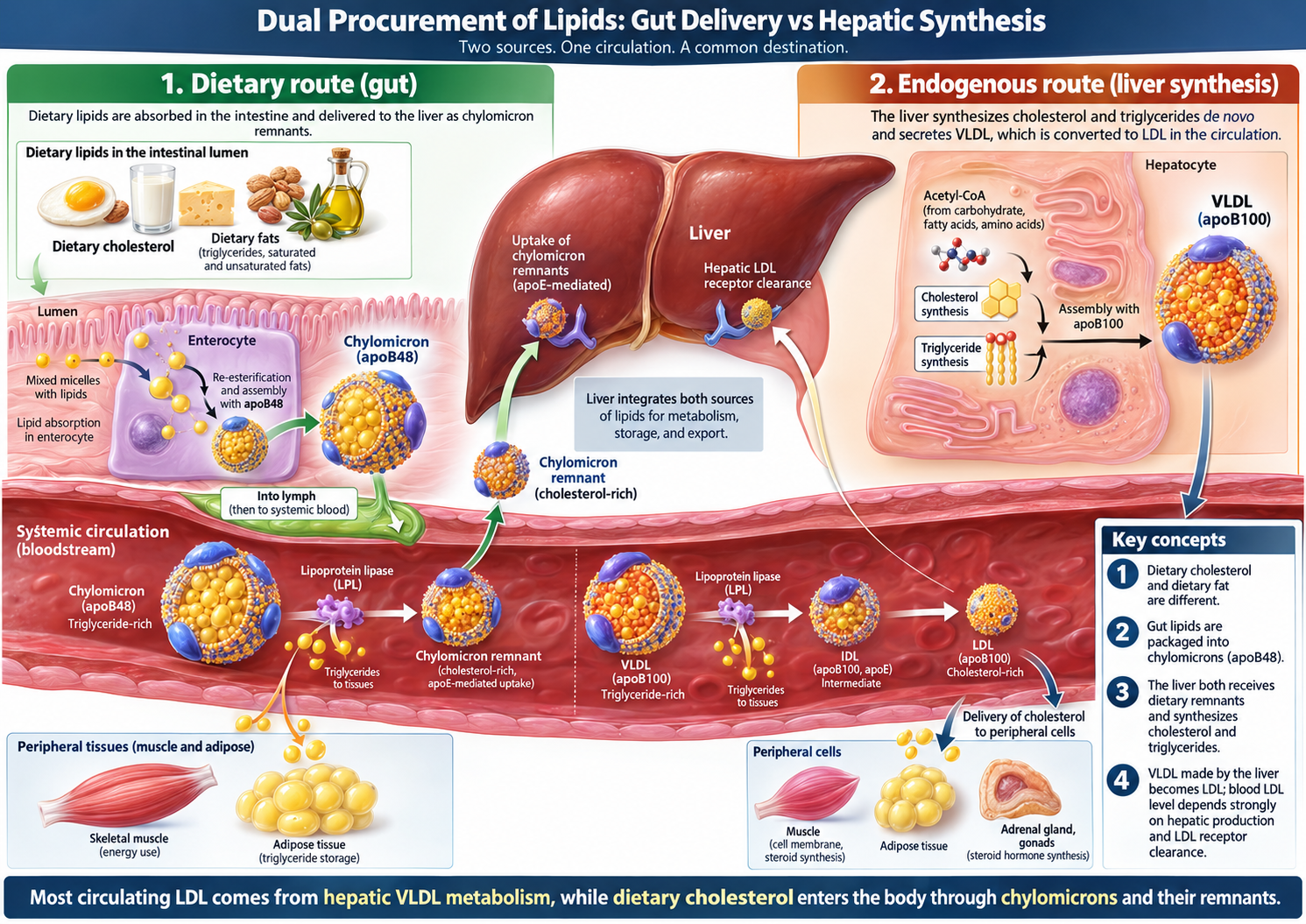
The second is more personal and much less often measured: how much of your circulating atherogenic particle burden is actually modifiable by what you eat. That is not a rhetorical question. It has a number, it differs enormously between people, and it can only be established by measurement in the person concerned.
What food can actually do
The dietary approach with the most convincing lipid data is the portfolio pattern developed by Jenkins and colleagues in Toronto: viscous fibre, plant protein, nuts and phytosterols assembled deliberately on a low saturated fat background. Pooled across controlled trials in people with hyperlipidaemia, that combination lowered LDL cholesterol by around 17%, or roughly 0.73 mmol/L, and moved non-HDL cholesterol, ApoB, triglycerides, blood pressure and C-reactive protein in the same direction. Delivered as ordinary dietary advice to free-living people rather than as supplied meals, the effect is smaller and depends heavily on how closely the pattern is followed.
The individual components each contribute a modest, well-characterised amount. Around three grams a day of oat beta-glucan — a large bowl of porridge, or oat bran worked into other meals — lowers LDL cholesterol by roughly a quarter of a millimole per litre, with smaller reductions in non-HDL cholesterol and ApoB. Plant sterols and stanols at two to three grams a day, taken in fortified spreads, yoghurts or drinks, lower LDL cholesterol by something in the order of 10%, with little further gain above about three grams. Reducing saturated fat lowers serum cholesterol reliably; what the trial evidence is far less settled about is which nutrient should take its place, and the Cochrane review of the randomised evidence is explicit that replacement with polyunsaturated fat, monounsaturated fat, carbohydrate or protein are not interchangeable propositions.
Two further levers sit alongside the plate rather than on it. Losing visceral fat tends to lower triglycerides and raise HDL cholesterol, sometimes substantially, and usually improves glycaemia at the same time. Alcohol and refined carbohydrate act mainly on triglycerides, and in some people the triglyceride response to removing them is dramatic. Stack all of this together in a highly adherent person and a fall in LDL cholesterol and ApoB of the order a low-intensity statin would achieve is realistic. Stack it together in the average person, in an average week, and it is not.
Responders, non-responders, and why averages mislead
Every figure in the paragraphs above is a mean. Means conceal the thing patients most want to know. The classic demonstration comes from Katan’s group in Wageningen, who fed ninety-four healthy volunteers a controlled cholesterol load and found a mean rise in serum cholesterol of 0.50 mmol/L with a standard deviation of 0.39 — a spread almost as wide as the effect itself. When people identified as apparent hyper-responders and hypo-responders were brought back for two further controlled experiments, the difference between the groups persisted, which is the strongest evidence we have that responsiveness is a real and stable individual characteristic rather than an artefact.
The same group was equally clear about the limitation, and it is the limitation that shapes how this test is designed. Because serum lipids vary substantially within the same person from week to week, a single pair of measurements — one before a dietary change, one after — cannot reliably tell you whether someone is a genuine responder. Within-person variation in serum cholesterol is present even under the controlled conditions of dietary intervention trials, and it is greater in ordinary life, with triglycerides the most volatile measure of all. One reading is a snapshot. Two readings are a line drawn through two points, and a line through two points can be drawn through noise. Three readings, spaced over six months, begin to describe a trajectory.
Diet is not an exam you pass or fail. It is a single variable, changed deliberately, and then measured — more than once, because one measurement cannot tell the signal from the week you had.
Why we measure ApoB, and why Lp(a) is measured once

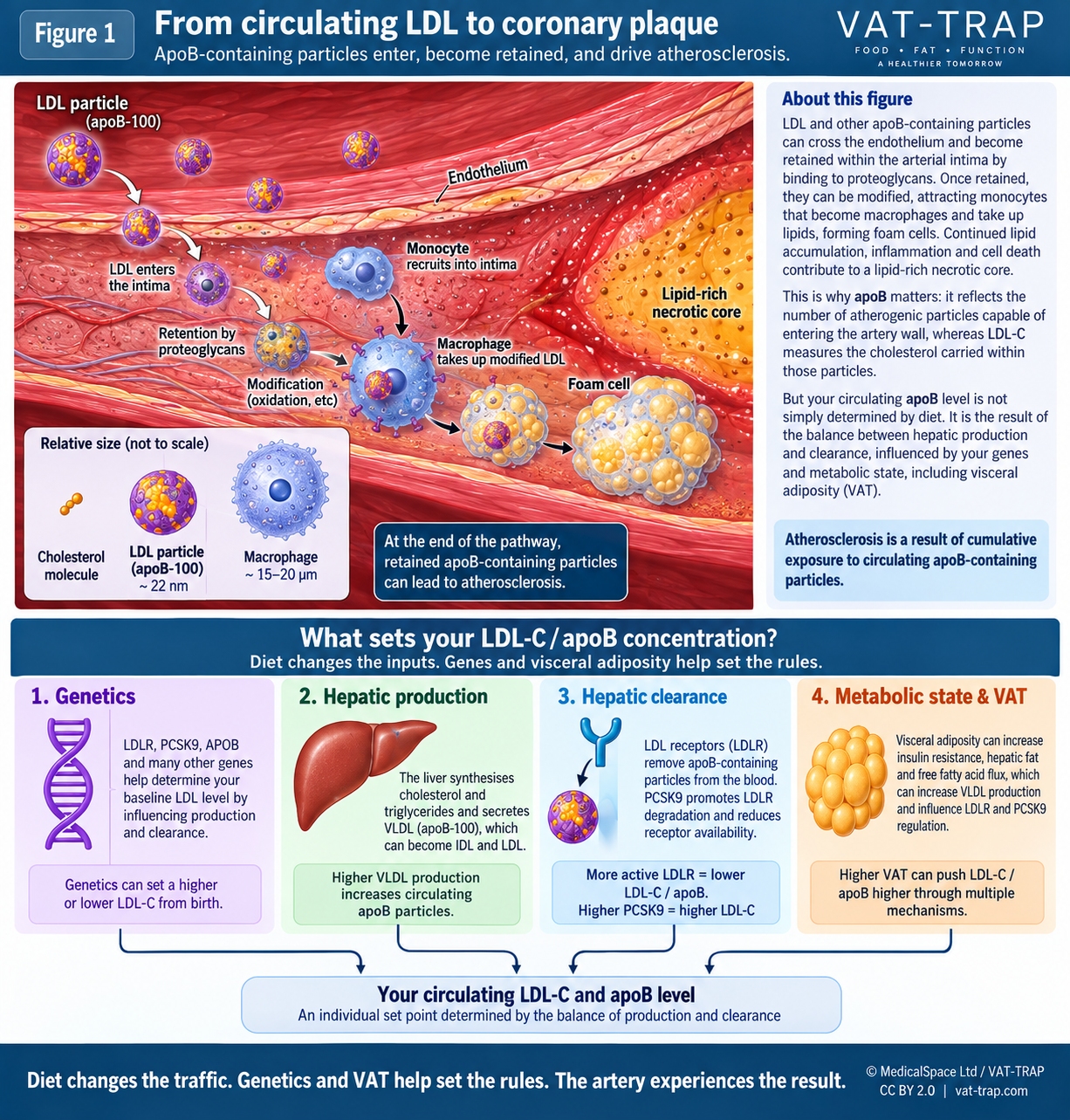
Apob B and LDLC cause atherosclerosis. ApoB particles are the delivery vehicles. The artery experiences their cumulative traffic. Figure from The VAT-TRAP book series. © MedicalSpace Ltd / VAT-TRAP. CC BY 2.0.
Cholesterol can only enter the arterial wall inside a particle, and every atherogenic particle — LDL, VLDL, remnant, Lp(a) — carries exactly one molecule of apolipoprotein B. ApoB therefore counts the particles rather than weighing their cargo, and because the amount of cholesterol carried per particle varies between people, LDL cholesterol and ApoB can disagree about how much risk someone is carrying. Where they disagree, the particle count is the better guide. This matters particularly when diet shifts triglycerides, because the cholesterol-to-particle relationship moves at the same time and an LDL cholesterol result on its own can flatter or unfairly penalise the change you have made.
Lipoprotein(a) is a different kind of measurement. It is largely genetically determined, it varies little across a lifetime, and it is a causal and continuous contributor to risk that remains relevant even at low LDL cholesterol levels. Diet will not change it. Knowing it changes where your ApoB target should sit, which is why it is offered once, as an option, rather than tracked.
Why HbA1c is measured at the start and at the end
Statins carry a small but genuine effect on glucose metabolism. The 2010 collaborative meta-analysis of randomised statin trials found a modest excess of new diabetes diagnoses on treatment, and the more recent individual participant data analysis from the Cholesterol Treatment Trialists’ Collaboration confirmed both an increase in new-onset diabetes diagnoses and a small worsening of glycaemia among people already living with diabetes. The absolute effect is small and, for anyone at meaningful cardiovascular risk, it is comfortably outweighed. But it is real, it is measurable, and it is far easier to interpret if you know where the person started.
There is a second reason, which applies whether or not medication is ever started. Some of the dietary strategies that improve a lipid panel — particularly the low-carbohydrate approaches people often reach for when triglycerides are high — change carbohydrate and fat intake at the same time, and the glycaemic consequence is not always in the direction expected. An HbA1c at baseline and again at the end of the six-month sequence means the lipid result is never bought with a metabolic change that nobody looked for. If a statin is started during the sequence, the same two measurements let you separate its effect from the diet’s.
The Cholesterol Sequence Test
The CST is built for people who want to measure the real impact of diet, of medication, or of both, on the factors that drive future cardiovascular risk — and who would rather find out what their own physiology does than assume it behaves like the average of a trial population. What it delivers is a specialist-grade read on cardiovascular risk, with the option to trial dietary change first and track, on paper, whether it is working.
Three testing points over six months. The package includes:
- A preliminary health questionnaire, completed online.
- A baseline fasting blood panel: total cholesterol, LDL, HDL and non-HDL cholesterol; the total cholesterol to HDL ratio; triglycerides (an eight-hour fast is required); apolipoprotein B; and HbA1c.
- A full medical report from a doctor, setting out your basic risk group, your guideline-based ApoB and LDL targets, and how your later results will be tracked against them.
- Two further fasting lipid and blood sugar profiles at three-monthly intervals, with HbA1c repeated at the final test.
- An optional Lp(a) measurement, at additional cost, for a more precise personal risk assessment.
Once you have your baseline result and your targets, the next move is yours: whether to trial dietary measures to lower LDL cholesterol and triglycerides, raise HDL cholesterol, or all three. Every three months a repeat fasting profile is arranged and sent both to you and to your doctor or specialist nurse, so that the response to diet, to medication, or to the combination can be assessed together rather than in isolation.
The basic price of £399 covers your initial results, targets and medical report , plus the two subsequent lipid and blood sugar profiles at three-month intervals. Samples can be taken at home, at a partner clinic, or through a home phlebotomy service. For more information on the home testing, operated by the surrey cardiovascular clinic see https://shop.scvc.co.uk/product-page/cholesterol-sequence-testing.
What the sequence does not do
It is worth being plain about the limits. The CST is not a substitute for formal cardiovascular risk assessment, which in the UK rests on QRISK3 and the wider clinical picture rather than on a lipid panel alone. It is not a diagnostic pathway for familial hypercholesterolaemia, which requires a different assessment and, where indicated, genetic testing. It is not a screening test for coronary disease; if imaging is warranted, that is a separate conversation. And serial lipid measurement, however well sequenced, has not itself been validated as a risk-stratification instrument in outcome trials — it is a way of seeing whether a chosen intervention is working, not a new way of predicting events.
Nor does a good dietary result automatically mean medication can be avoided. For someone with established disease, a high Lp(a), or a risk profile well above threshold, the target may sit further down than diet alone can reach, and deferring treatment to keep trying has a cost measured in exposure over time. What the sequence does is put a number on the question. Whether that number changes the decision is a matter for you and the clinician who knows your history.
If you want to explore this topic in more detail, try out our ‘AI Companion Pack’ tool at the bottom of the article. Use the very guidance for our cardiometabolic clinics to get your favorite AI to peruse your own personal situation- whether you have just QRISK3 variables, Coronary Artery Calcification (CAC) score or a full Fat attenuation index (FAI) score – all of which we use to determine your risk and your target Apo B and LDL-C. If you need testing then look at ordering a home CST and discover own pathway to a healthy cholesterol level, based on latest evidence.
Related Blog Articles
- LDL: the lower the better https://www.scvc.co.uk/cholesterol-atherosclerosis/ldl-the-lower-the-better/
- What are the latest guidelines target for LDL? https://www.scvc.co.uk/cholesterol-atherosclerosis/ldl-guideline-targets/
- UK Cholesterol, Apo B, LDL-C Targets https://www.scvc.co.uk/cholesterol-atherosclerosis/uk-ldl-apob-targets/
- Will PCSK9 Inhibitors replace statins? https://www.scvc.co.uk/cholesterol-atherosclerosis/pcsk9-inhibitors-vs-statins/
- What the heck is LP(a)? https://www.scvc.co.uk/cholesterol-atherosclerosis/what-is-lpa/
Referenced version (UK English only):
https://mhaat.vercel.app/s-diet-cholesterol-and-the-question-no-one-can-answer-in-advance.html