Tags: Cholesterol, Coronary heart disease, CHD, PCSK9, Statin, LDL, search website using Tags to find related stories.
The latest European and UK guidelines reflect the finding that there is no lower limit for LDL yet discovered, basically meaning the lower the LDL the lower the risk of future cardiovascular events. These recommendations come after new trials with lower targets showed better outcomes. As a result, millions of people taking statins around the world need to be looking more carefully at whether they are taking sufficient medication to lower their LDL to these new targets if the very best outcomes are to be achieved.

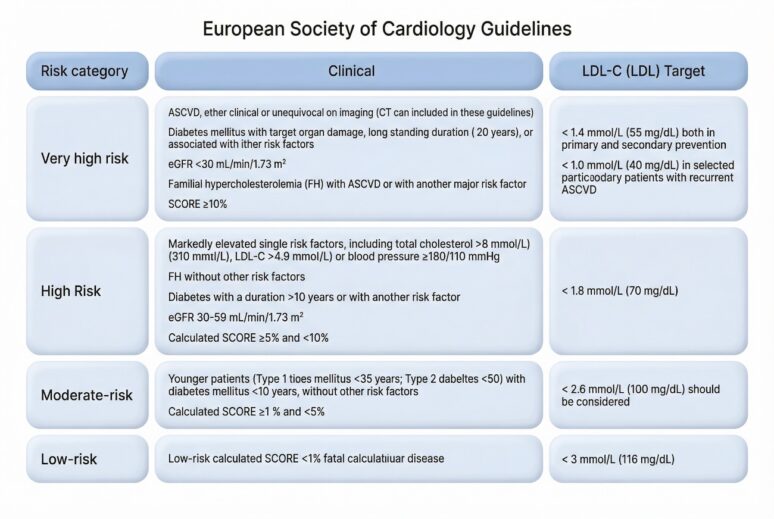
Summary table showing the target LDL recommended by the European Society of Cardiology from reference [2] Mach F, et al. 2019 ESC/EAS Guidelines for the management of dyslipidaemias: lipid modification to reduce cardiovascular risk. Eur Heart J. 2020 Jan 1;41(1):111-188. doi: 10.1093/eurheartj/ehz455
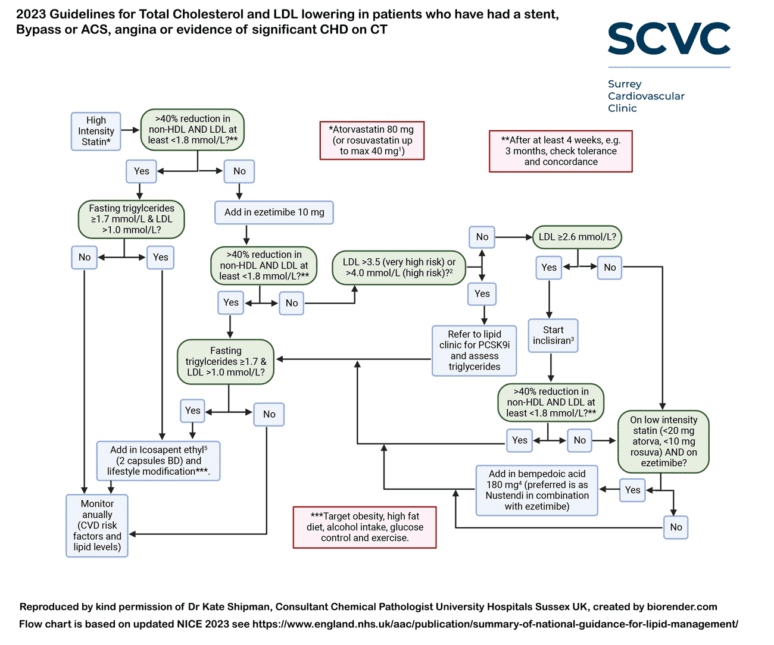
NHS and NICE approved pathways to prevent coronary heart disease in patients shown to be at increased risk
Some research suggests that non-HDL cholesterol may be a better predictor of heart disease than LDL cholesterol. This is because non-HDL cholesterol includes all the atherogenic lipoprotein particles, which transport triglycerides to tissues. These particles eventually turn into LDL. The NHS elected to simplify population blood testing for lipids, by measuring a random (non fasting) total blood cholesterol and HDL Cholesterol fraction. The term ‘non HDL cholesterol’ is widely used as an approximate equivalent to LDL and is simply derived by subtracting the HDL from Total Cholesterol.
For patients who have been diagnosed with an acute coronary syndrome, requiring bypass surgery or stent, or have CT Angiography and or raised FAI where the risk of future coronary events is increased, effective secondary prevention is required. The target LDL in such patients has been lowered to <1.8 mmol/L.
Download the guideline as PDF Locally-developed-Lipid-SCVC
- 2019 Guidelines on Dyslipidaemias (Management of) ESC Clinical Practice Guidelines
- European Society of Cardiology 2024: Lipidology update: targets and timing of well-established therapies