A simple app that turns your phone into a heart rhythm recorder could be the most important thing you share at the Christmas table this year.
Declaration of interest: this article mentions services provided by Surrey Cardiovascular Clinic. Dr Edward Leatham founded SCVC and is its majority shareholder, and has financial interests in some of the services it uses.
Full disclosures →
For busy people, or to tune in when on the move, a Google NotebookLM audio podcast is available as a story beneath.
Why Atrial Fibrillation Is Still Catching Us Off Guard
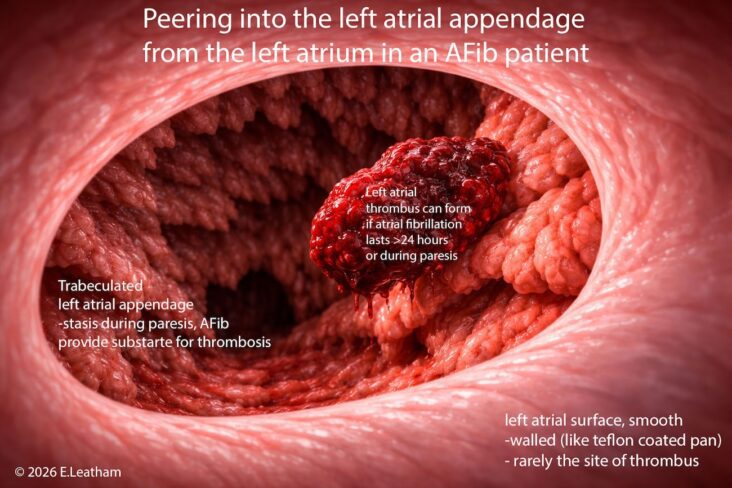
AF is the commonest sustained cardiac arrhythmia in clinical practice, affecting roughly 1.4 million people in the UK, with a similar number estimated to remain undiagnosed. When the upper chambers fibrillate, blood pools within the left atrial appendage; clot forms, fragments break off, and in a substantial proportion of cases the result is a cerebral artery occlusion. AF is responsible for approximately one in five ischaemic strokes, and those strokes are on average more severe and more likely to be fatal or permanently disabling than strokes from other causes. Crucially, AF-related stroke is largely preventable: anticoagulation with DOACs such as apixaban or rivaroxaban reduces cardioembolic stroke risk by roughly two-thirds. The therapeutic lever exists. The problem is finding the people who need it before the stroke occurs.
The fundamental challenge is that AF is frequently paroxysmal, and a significant proportion of patients either have no symptoms at all or attribute what they feel to tiredness or ageing. A single resting ECG captures only a moment in time. If that moment falls during sinus rhythm, the ECG is normal, and the clinician has no reason to investigate further.
AliveCor and the Technology That Changes the Equation
The AliveCor KardiaMobile system allows anyone to record a single-lead ECG in approximately thirty seconds. The user places their fingertips on two small metal electrodes, the device samples the electrical signal through the skin, and the app produces a rhythm strip immediately analysed by an FDA-cleared and CE-marked algorithm, classifying the recording as normal sinus rhythm, possible AF, unclassified, or unreadable. The resulting trace can be exported as a PDF and shared directly with a clinician.
NICE guidance on AF (NG196) endorsed single-lead ECG devices as an appropriate tool for AF detection in symptomatic patients. The device costs in the region of thirty to fifty pounds, requires no prescription, and produces a recording of sufficient clinical quality that most cardiologists and GPs will act upon it.
The Familial Dimension — Why This Is Everyone’s Business
AF is also heritable. Analyses from the Framingham Heart Study cohort have demonstrated that having a first-degree relative with AF approximately doubles an individual’s lifetime risk of developing the arrhythmia. If your patient has AF, their adult children, siblings, and parents are a higher-risk group than the general population, and many of them will have no idea.
If the patient in front of you is established on anticoagulation and has adult children who have never been screened, showing them how to use the AliveCor app before they leave the consultation is a low-effort, high-value intervention that takes under two minutes.
The Christmas Table Argument — Opportunistic Screening in the Real World
The scenario that motivates this most compellingly is the fifty-five-year-old sibling who has not seen a GP in four years, considers themselves well, and whose only cardiovascular risk factor is a parent with AF. If offered a party trick at Christmas dinner, they will almost certainly hold two fingers against a small metal plate for thirty seconds. If the resulting trace shows the chaotic, irregularly irregular pattern of AF, there is now information where there was none before.
One important practical caveat: a result classified as normal sinus rhythm does not exclude paroxysmal AF in someone with symptoms or a strong family history. A normal AliveCor recording in a symptomatic or high-risk individual should prompt further evaluation — a prolonged Holter monitor or implantable loop recorder — rather than definitive reassurance.
What GPs Should Do With an AliveCor Recording
If a patient presents with a trace classified as possible AF, review the trace itself. The features of AF on a single-lead recording are the same as on a 12-lead: absent P waves, fibrillatory baseline activity, and an irregularly irregular R-R interval. If those features are present in a good-quality trace, the recording is clinically significant. Confirm with a 12-lead ECG if the patient is currently symptomatic, initiate CHA₂DS₂-VASc scoring, consider anticoagulation in line with NG196 if the score warrants it, and arrange cardiology review.
If the trace shows sinus rhythm but the patient describes intermittent palpitations with sudden onset and offset, a single normal AliveCor recording does not close the case. A 24- or 48-hour Holter is the appropriate next step, escalating to an implantable loop recorder if symptoms remain unexplained.
 A heart rhythm recorder works with most smartphones Although designed for personal use a heart rhythm recorder is used in many GP surgery’s for opportunistic AFib screening. By passing it around the tabe you can screen your own family and raise awareness about preventing a stroke! |
Key Takeaways
1
Atrial fibrillation causes approximately one in five ischaemic strokes in the UK, and the vast majority of cases affected were not aware they had Atrial fibrillation prior to the stroke or TIA
2
Anticoagulants (not Aspirin) are highly effective in preventing left atrial thrombus causing the stroke in these patients
3
Atrial fibrillation affects more people with age and has a large heredible component so families affected by atria fibrillation and /or stroke need to be more vigilant.
4
A simple heart rhythm monitor or app can be used to diagnose atrial fibrillation and data should be taken to your GP to get advice.
Summary
Atrial fibrillation is a leading hidden cause of stroke, often missed because it comes and goes without warning. A small device called AliveCor KardiaMobile turns any smartphone into a clinical-grade ECG recorder. Here is what every patient and GP needs to know about using it at home.